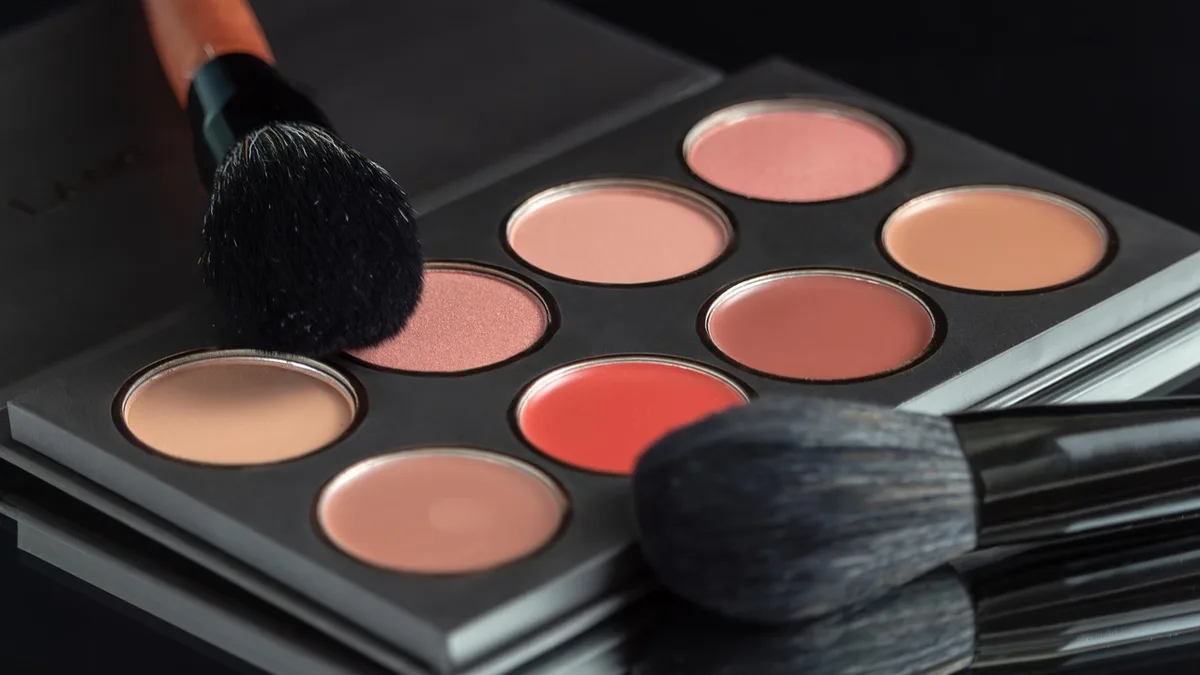
Blush: Formulation Secrets, Pigments, and European Regulatory Requirements
Blush (or rouge) is a signature cosmetic product created to impart vitality, warmth, and sculpted structure to the cheekbones. Available as pressed compact powder, loose mineral veil, or creamy cheek balm, its formulation combines inert mineral fillers, vibrant colorants, and lipid binders. However, its direct, repeated application to facial skin demands strict dermal tolerance testing and verified colorant purity under Regolamento (CE) N. 1223/2009. Here is our complete compliance guide.
💡 Launching a line of blushes, bronzers, or complexion powders? Ensure the regulatory compliance of your facial makeup formulas. Estimate your costs in 2 minutes with our configurator.
Blush Formulation: Dry Powders, Pigments, and Pan Cohesion
A pressed powder blush relies on a calibrated physical equilibrium between dry pulverulent powders and a liquid binder to ensure solid compaction without breaking or dusting during transit:
- The pulverulent base (substrate): talc (INCI: Talc), mica (INCI: Mica), or silica. They deliver a velvety touch, silky skin feel, and facilitate smooth, seamless color blending. Cosmetic talc must be certified 100% free from asbestos fibers.
- The colored phase (pigments): iron oxides (CI 77491, CI 77492), titanium dioxide (CI 77891), and organic red and pink color lakes authorized under Annex IV of the Cosmetic Regulation.
- The lipid binder (cohesion): tailored combinations of botanical oils (jojoba, squalane) or synthetic esters that bind powder particles under hydraulic pressure inside the metal pan.
The PIF compiles all technical formulation parameters, colorant purity assays, and physical stability data. To understand the overarching European regulatory requirements for color cosmetics, consult our guide on makeup cosmetic regulation and our reference page on the general PIF cosmetici.
🔬 Insights from our Valutatore della Sicurezza Cosmetica
"Anhydrous pressed powder blush containing zero free water presents an exceptionally low microbiological risk under ISO 29621. It is consequently exempt from preservative challenge testing, simplifying the technical dossier. Conversely, verifying talc purity (absence of asbestos fibers) and analyzing heavy metal impurities (lead, arsenic, cadmium, mercury) in colored pigments are mandatory prerequisites for signing the Cosmetic Product Safety Report (CPSR (Cosmetic Product Safety Report)). For emulsion-based liquid or cream blushes containing water, challenge testing remains strictly required."
Steps for Regulatory Compliance of Your Blush Range
To legally market your blush line in France, Switzerland, and across the EU, you must complete the following stages:
- Stability and compaction testing: accelerated stability testing at 40°C for 8 to 12 weeks to confirm chemical stability and standardized drop testing (drop test) to validate the physical resistance of the pressed cake in its compact.
- Cosmetic Product Safety Report (CPSR (Cosmetic Product Safety Report)): drafting and formal sign-off of Parts A and B by our qualified Valutatore della Sicurezza. Allergen concentrations, dermal tolerance data, and raw material purity profiles are rigorously evaluated.
- Labeling compliance review: verifying the mandatory INCI list, net weight, batch number, PAO (Period After Opening) or Minimum Durability Date (Best before end), and persona responsabile contact details.
- CPNP notification: mandatory product registration on the European Cosmetic Product Notification Portal prior to placing on the market.
Our regulatory team provides turnkey support for your cosmetic projects. Review our service packages and pricing in our dedicated PIF services guide.
⚠️ 3 Frequent Regulatory Risks in Blush Formulations
- Heavy metal impurities in mineral colorants: iron oxides and lakes must be of cosmetic grade, with heavy metal impurities well below the strict safety limits recommended by the SCCS.
- Asbestos contamination in talc: talc raw materials must be certified asbestos-free through X-ray diffraction (XRD) or transmission electron microscopy (TEM) testing.
- Physical instability under thermal stress: an improperly balanced binder ratio causes the pressed powder cake to crack, shrink, or separate under 40°C accelerated thermal stability conditions.

Cross-Regulatory Links with Related Complexion Products
If you are formulating complementary face makeup cosmetics, review our related technical guides:
- For liquid and cream complexion bases, see our guide on liquid foundation PIF.
- For complexion illuminators, consult our guide on highlighter makeup PIF.
- For overall face makeup regulatory standards, read our guide on complexion makeup regulation.
Frequently Asked Questions About Blush PIF
- Does mica used in shimmering blushes have to be ethically certified?
- Under European Cosmetic Regolamento (CE) N. 1223/2009, mica (CI 77019) must satisfy strict chemical purity criteria and heavy metal safety limits. Ethical certification (such as supply-chain auditing guaranteeing the absence of child labor via the Responsible Mica Initiative) is a voluntary CSR commitment. While highly recommended for commercial brand reputation, it is not an explicit legal requirement under EU cosmetic law.
- Is container-content compatibility testing required for blush metal pans?
- Yes. Pressed powder blushes are compacted into metal godets (tinplate or aluminum) housed within cosmetic compacts. Accelerated stability testing (8 to 12 weeks at 40°C) confirms that formula binders and fatty acids do not corrode, oxidize, or interact chemically with the metal pan.
- How should a cream blush be formulated for PIF compliance?
- A cream blush replaces dry filler powders with a matrix of botanical waxes, vegetable butters, and cosmetic esters. Because an anhydrous cream contains no free water, an ISO 11930 challenge test (ISO 11930) is not required. However, thermal stability testing at 40°C is strictly necessary to ensure the balm does not melt, separate, or sweat during storage.

Configurez votre projet en direct
Calculez le tarif de votre DIP Cosmétique
Définissez votre profil, votre type de formule et vos besoins en tests de laboratoire pour obtenir une estimation instantanée et transparente.