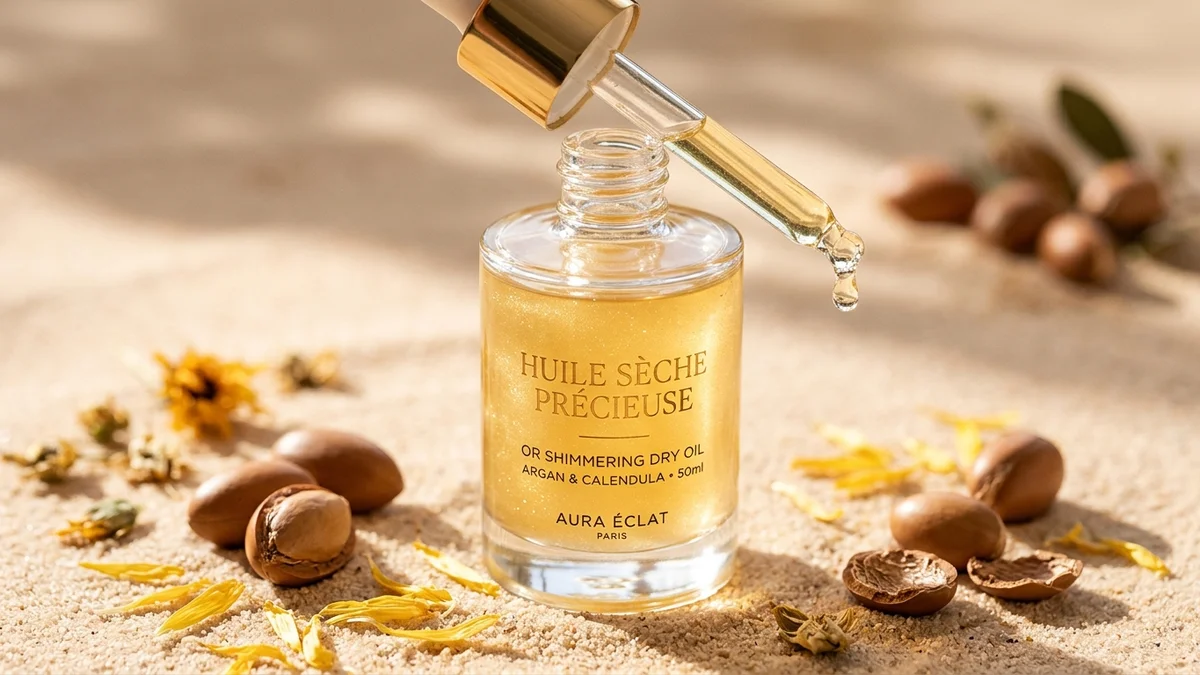
Dry Oil: Dry-Touch Formulation Secrets and EU Regulatory Compliance
Dry oil is an immensely popular multi-use body and hair care format, delivering the deep nutritional benefits of botanical lipids without leaving a greasy residue on skin or hair. Formulated primarily with natural-origin esters and light vegetable oils, it exists as an anhydrous liquid blend. Marketing a dry oil across Europe requires satisfying the toxicological and physical safety standards of Regolamento (CE) N. 1223/2009. From oxidation control to full PIF compilation, discover our comprehensive regulatory guide.
💡 Launching a dry oil or anhydrous nourishing body oil? Ensure the regulatory compliance of your formulas. Estimate your costs in 2 minutes with our configurator.
The Chemistry of Dry Oil: Esters, Botanical Lipids, and Evanescent Finish
The characteristic "dry touch" finish of a dry oil is achieved by balancing lipid ingredients that spread rapidly and absorb quickly into the stratum corneum:
- Natural-Origin Esters (The Dry-Touch Base): Coco-Caprylate/Caprate, Dicaprylyl Ether, or Isopropyl Myristate. These plant-derived ingredients exhibit low surface tension and low viscosity, penetrating rapidly without leaving a shiny, occlusive film.
- Nutritive Botanical Oils (The Care Phase): Macadamia seed oil (INCI: Macadamia Integrifolia Seed Oil), jojoba oil (INCI: Simmondsia Chinensis Seed Oil), or argan oil. They deliver essential fatty acids to nourish the epidermal barrier and smooth the hair fiber.
- Antioxidants (Oxidative Stability): Tocopherol (vitamin E) is indispensable to prevent oxidative rancidity in unsaturated botanical oils exposed to ambient air.
The PIF compiles all formulation, analytical stability, and safety records. To understand the broader regulatory context for decorative and body cosmetics, consult our guide on makeup regulatory compliance and our primary guide on the PIF cosmetici.
🔬 Insights from our Valutatore della Sicurezza Cosmetica
"Because dry oils are frequently applied over large cutaneous surfaces (full body and hair), systemic exposure calculated in the CPSR (Cosmetic Product Safety Report) is substantial. As an anhydrous liquid formula containing no free water, dry oil is classified as a low microbiological risk product under ISO 29621 and is exempt from challenge testing. However, accelerated physicochemical stability testing at 40°C and peroxide value monitoring (measuring lipid oxidation) are required to substantiate the shelf life for the PIF."
Regulatory Steps to Ensure Compliance for Dry Oils
To market your dry oil legally in France or across the EU, execute the following steps:
- Thermal Stability and Packaging Compatibility: Accelerated thermal aging tests at 40°C over 8 to 12 weeks to confirm the formula remains clear (no cloudiness, precipitate, or phase separation) inside its glass bottle or spray dispenser.
- Cosmetic Product Safety Report (CPSR (Cosmetic Product Safety Report)): Toxicological assessment and formal sign-off by our qualified expert, with meticulous calculation of fragrance allergens.
- CPNP Registration: Mandatory notification of every finished cosmetic shade on the European Cosmetic Products Notification Portal prior to distribution.
Our team delivers complete regulatory compliance packages. Find out more about our packages and transparent pricing on our PIF services page.
⚠️ 3 Frequent Compliance Pitfalls in Dry Oils
- Oxidative Rancidity in Vegetable Oils: Omitting adequate antioxidant protection (tocopherol) causes sensitive polyunsaturated oils to oxidize rapidly, generating unpleasant odors and skin-irritating lipid peroxides.
- Undeclared Fragrance Allergens: If your perfume or essential oil blend contains geraniol, linalool, or limonene above 0.001% (the strict threshold for leave-on body care), they must appear in the INCI list.
- Unsubstantiated Instant Absorption Claims: Advertising an "immediate dry touch" without sensory panel evaluations or instrumental absorption testing can be contested by advertising standards authorities.

Regulatory Cross-Linking Across Product Categories
If you also formulate decorative or eye makeup products, consult our associated guides:
- For precision eye liners, explore our guide on eyeliner regulation & PIF.
- For eye lash enhancing formulas, read our guide on mascara eye safety & PIF.
- For powder pigment cosmetics, check our guide on eyeshadow pigment regulation.
Frequently Asked Questions on Dry Oil Regulations
- Is container compatibility testing required for glass spray bottles?
- Yes. Dry oils are frequently packaged in glass bottles fitted with fine-mist spray pumps. During accelerated stability testing (8 to 12 weeks at 40°C), the laboratory confirms that the formula does not degrade the plastic dip tube or pump seals and that the spray mechanism dispenses consistently without clogging or leaking.
- Can volatile silicones be used to create a dry-touch finish?
- Volatile silicones (cyclopentasiloxane - D5, cyclohexasiloxane - D6) have historically been used in conventional cosmetics for an evanescent, silky finish. However, cyclic silicones face strict European environmental and consumer safety restrictions. In organic cosmetics (Cosmos Organic), silicones are strictly prohibited and replaced by plant-derived esters.
- How do you evaluate phototoxicity risks for dry oils?
- If a dry oil contains citrus essential oils (such as lemon, bergamot, or sweet orange), it contains furocoumarins (psoralens), which are phototoxic substances that trigger hyperpigmentation upon sun exposure. The Valutatore della Sicurezza ensures that furocoumarin concentrations comply with Annex III restrictions (limited to under 1 ppm in leave-on cosmetics applied to sun-exposed skin).

✨ Vous formulez des huiles parfumées pour le corps, la barbe ou les cheveux ? Consultez notre accompagnement dédié au DIP Parfumerie & Produits Corporels Parfumés (380 € HT), ainsi que nos guides pour le parfum solide et la brume corporelle.
Configurez votre projet en direct
Calculez le tarif de votre DIP Cosmétique
Définissez votre profil, votre type de formule et vos besoins en tests de laboratoire pour obtenir une estimation instantanée et transparente.